

Table of Contents[Hide][Show]
This is a paid blog post written for Vita Stream, which means I was compensated to publish it. But I have used Vita Peptides bioregulators in my own perimenopause journey for over a year now, and I would not put this info on my site if I could not completely stand behind the experience. This is not medical advice, a diagnosis, or a reason to start or stop any protocol without your own practitioner.
Most women I know do not need just another supplement.
They need someone to explain, in plain language, what they are being asked to swallow. And whether it has anything to do with the season they are actually in.
What will this thing actually do for me?
I was in perimenopause and just so tired of guessing. Sleep had become unreliable in a way that felt cumulative, like my body was keeping a running tab of every night it did not fully restore. Recovery from anything — a hard week, a stressful season, even a good workout — took longer than it used to. I had already been through the experience of trying a hormone protocol that backfired on me (I wrote that story here), and once I had my genetic testing done, I understood exactly why it backfired. So when I started looking at peptide bioregulators, I was not optimistic or enthusiastic about adding something new. But I knew my hormones were off even if it wasn’t blatantly showing up on lab work. I was just paying attention, the way you do when you have already learned that the wrong fit costs you more than the right one.
All that to say, I wasn’t looking for a miracle or an instant fix. I was looking for targeted support that came from understanding my own design, not from reverse-engineering what worked for someone else.
That is the lane peptide bioregulators live in, if they belong on your counter at all. Not a replacement for food, sleep, labs, or your design. A different kind of signal.
What a peptide bioregulator is, without the mystique
A peptide is a short chain of amino acids. Shorter than a protein, which is why the body absorbs it more easily. A peptide bioregulator is a specific kind of short peptide complex used as targeted nutritional support for a particular organ or system: liver, blood vessels, brain, thyroid, neuroendocrine signaling, and so on.
The idea behind the category — the work most people associate with Professor Vladimir Khavinson and decades of Russian gerontology research — is tissue-specific support. Different complexes are built around different tissues. You are not taking “a peptide.” You are taking support aimed at a system.
If you want the company’s own plain-language explanation, start here: Vita Stream’s peptide bioregulator FAQ.
Two things I want you to hear before the marketing voice gets in the room.
First: these are dietary supplements in a capsule. They are not prescription peptide injections, not compounded research peptides, and not hormone replacement. They are not a substitute for a clinician, and they are not a diagnosis in a bottle.
Second: “natural” in this category usually means complexes derived from specific animal tissues, filtered down to very small peptide fractions. That matters if sourcing is part of how you decide what belongs in your supplement stack. Read labels, ask questions, and do not assume it is a plant powder because the word natural is on the page.
These are not the peptides people are fighting about online
If you have spent any time in wellness spaces lately, the word “peptides” probably makes you think of something else entirely: injectable compounds, gray-market vials, weight-loss shots, and forum stacks with names that sound like a lab notebook. That world has gotten extremely loud. But it is also a different category.
Peptide bioregulators are short, tissue-specific complexes in a pill form. They are not semaglutide and they are not a bodybuilding vial. Hey, I do not need you to love the entire peptide internet to consider whether a targeted capsule belongs in a perimenopause season. I needed that distinction myself before I would take them seriously.
Think of a bioregulator as a nudge, not a takeover.
Each tissue already knows how to work. With age, stress, and a season like perimenopause, that signaling gets quieter or sloppier. A bioregulator is a short message aimed at that tissue: remember how to do the job you already know how to do. It is not flooding the system with a hormone. It is not forcing an organ to sprint. It is merely a reminder.
That is also why I do not take them indefinitely. This is not a forever multivitamin. You use a course, you let the tissue receive the signal, and you stop. The company’s own material talks about cycles rather than staying on a bottle until it lives permanently in your cabinet. That matched how I wanted to use them. Support the system, and then recheck. See if another cycle is needed.
V1, V2, and why Vita Peptides showed up on my radar
Vita Stream sells more than one generation of this category. The short version: V1 is the original capsule form most people in this world started with. V2, the Vita Peptides line, is their next step: oral, easier to build into a daily routine, and formulated around a broader peptide profile rather than simply more powder in a bigger capsule.
They explain that difference here: V1 vs V2 peptide bioregulators.
The ones I actually took, and what I noticed
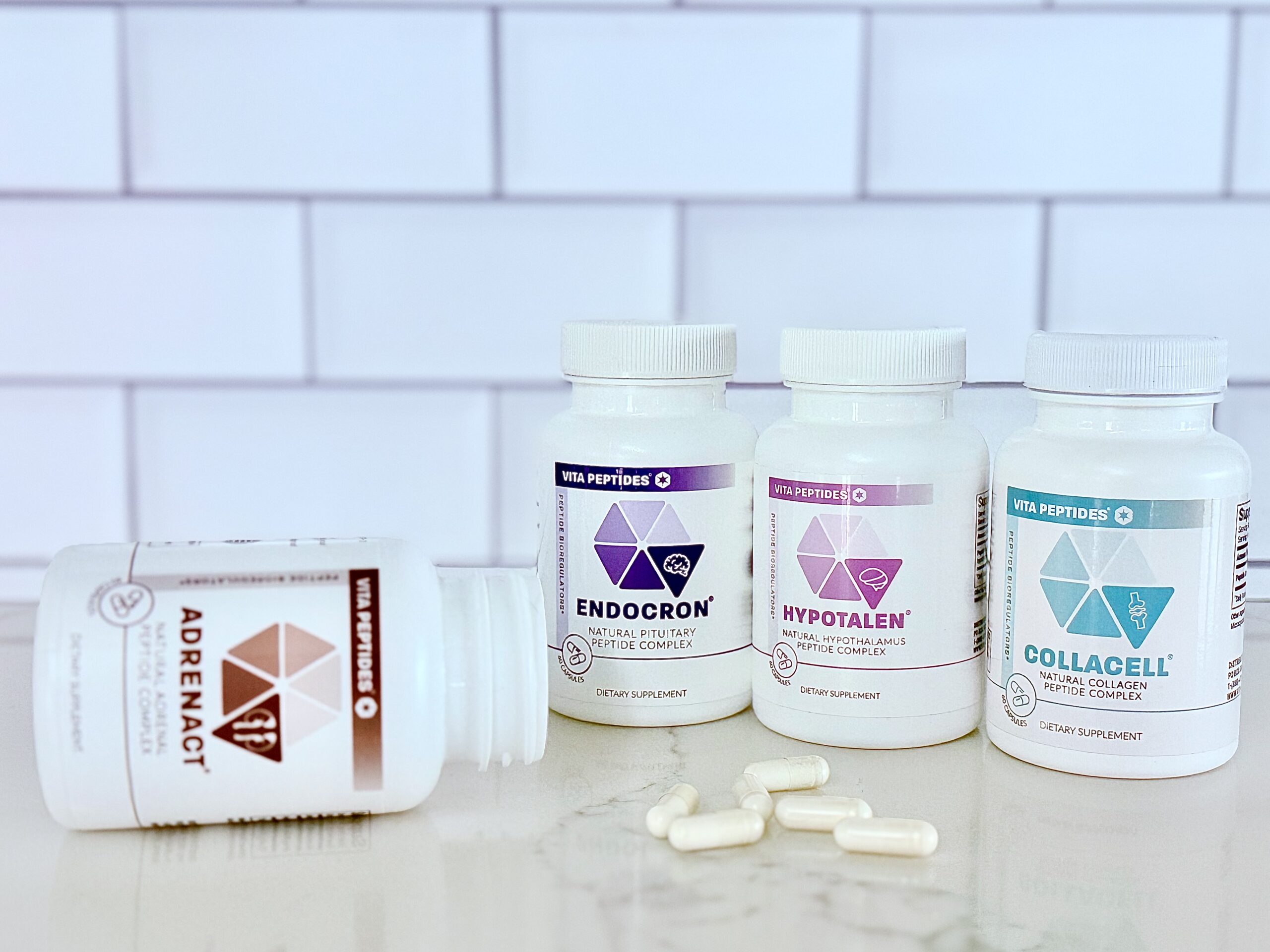
The Vita Peptides I used were Endocron, Hypotalen, Ovalis, Adrenact, and Collacell. I started with separate bottles because those were the systems that felt loudest in my perimenopause journey. Later I moved to Vita Woman, their combination capsule, because it folded several of those same tissues into one bottle and I did not need a row of jars on my counter forever.
I am not going to give you a before-and-after that sounds like an ad. This is just what I noticed in my own body.
Endocron is pituitary support. The pituitary sends the marching orders to the rest of the hormone cascade. In perimenopause, that cascade is already improvising. What I felt was not a jolt. It was more like the volume knob on “everything is slightly off” turning down. Sleep got more usable. I was not wired at midnight and wrecked at 6 a.m. in the same way.
Hypotalen is hypothalamus support. Think of the hypothalamus as the thermostat, the part of the brain that decides what “normal” even is. When that signaling gets sloppy, you feel it as temperature swings, sleep that will not deepen, and a stress response that does not know when to stand down. This was one of the quieter bottles, but also one I would not have wanted to skip. The days felt less jagged, I had more consistent energy throughout my waking hours.
Ovalis is ovarian support. This was the one I was most interested in taking when I first started researching bioregulators, because my cycles and regular ovulation was becoming erratic. I wanted support aimed at that tissue specifically, because I want to maintain my cycles for as long as naturally possible. As a result, the monthly weather around my cycle became much more predictable. Of course I still have other perimenopause symptoms, but they remain fairly mild.
Adrenact is adrenal support. This one made the most everyday sense to me. Perimenopause plus a full life plus a nervous system that already runs hot is a significant demand on the same glands, all day, every day. Plus, when your ovaries stop ovulating during the transition to menopause, they drastically scale back their production of estrogen and progesterone. At this stage, the adrenal glands step in as the primary backup source for sex hormone production. I want to keep my adrenals as healthy as possible to make this transition more manageable. After a cycle of this, my recovery after stress improved. I could actually come down from a hard day instead of carrying the leftover into the next morning.
Collacell is connective tissue support. When hormones shift, connective tissue gets louder: joints, skin, that “I slept wrong and now I am 80” feeling. This was not a vanity bottle for me, it was the physical body catching up to the season I was in. My genetics lean toward needing extra soft tissue support, and I’ve experienced frustrating aches and pains with my shoulder and SI joints. I’m still in the middle of this cycle so I’m hoping this will be a positive way to support this aspect of my health.
But I want to be clear about this — success with bioregulators does not usually arrive as a dramatic before-and-after. It tends to show up in the quieter, more ordinary moments that you almost miss because you are used to things feeling harder. You sleep through the night and realize, somewhere around day three of that happening, that you cannot remember the last time you did. You come home from a hard week and you actually decompress instead of carrying the residue of it into the weekend. Your joints stop being the first thing you notice when you get out of bed. The mental static that used to run in the background, that low hum of “something is off but I cannot name it,” gets quieter. Brain fog lifts enough that you finish a thought without losing it halfway through. You feel less reactive, not because life got easier, but because your system is not running quite so close to the edge.
If you have been following my genomics work, you already know why I will not say “this is the perimenopause protocol.” The same input lands differently depending on the wiring and the load. A bioregulator is still an input. Your body came with a manual, and this is one tool that made more sense once I understood mine.
Where this actually fits in a woman’s life
Perimenopause is not one problem. It is a season where clearance, stress chemistry, sleep architecture, thyroid output, and inflammation all start talking louder at once. A lot of women get handed one cream and told to wait six weeks. Some of them feel worse and quietly decide they are the problem.
They are not the problem. The fit is.
I do not use bioregulators as a workaround for a plan that was never built for me. I use them as targeted support alongside the rest of the picture: food, environment, nervous system, and the design questions I ask before I add anything new.
If you are curious about the women’s complex Vita Stream carries, that page is here: Vita Woman natural peptide bioregulator complex. Look at what is in it. Look at whether it matches the systems you and your practitioner are actually working on.
How I would decide, if I were you
Ask three questions before you spend the money.
What system am I trying to support, and why? “I saw peptides on Instagram” is not a reason. Fatigue plus poor recovery plus a loud perimenopause is closer to a reason, and still needs context.
What else is already on my plate? If your detox pathways are backed up, your sleep is wrecked, and you are already on a borrowed hormone stack, adding another targeted product does not automatically help. Sequence still matters.
Who is helping me interpret this? Short peptides aimed at specific organs are not the same thing as a B-complex from the grocery store. Work with someone who understands the category, or stay curious and go slowly.
The most useful page on their site for that slower look is the FAQ. Read it before you shop the homepage.
What this is not
It is not a replacement for Your Design Code. It is not proof that genes do not matter. It is not a reason to ignore mold, minerals, or a hormone plan that was never built for you.
It is one tool I have used, from a company I was paid to write about, that earned a place in my own perimenopause journey because it matched how I actually felt in my body. And I will absolutely use them again, when it’s time for another cycle.
If you want the map underneath the bottles, that work still lives here: Your Design Code.
Educational content only. Peptide bioregulators are supplements, not medicines. Work with your own practitioner before you add, change, or stop anything, especially if you are on hormone therapy, have a diagnosed condition, or are pregnant or nursing.







Leave a Reply